Your team knows 5S. They’ve participated in Kaizen events. They’ve mapped value streams, worked through root-cause exercises, and attended Lean training.
You’ve seen improvements happen.
And yet, months later, familiar problems return.
Improvement still seems to depend on the same handful of people. Managers solve problems differently. Successful changes in one area don’t necessarily spread to another. Teams may know the language of Lean without consistently applying the thinking behind it.
If that sounds familiar, the problem may not be that your organization needs another Lean tool.
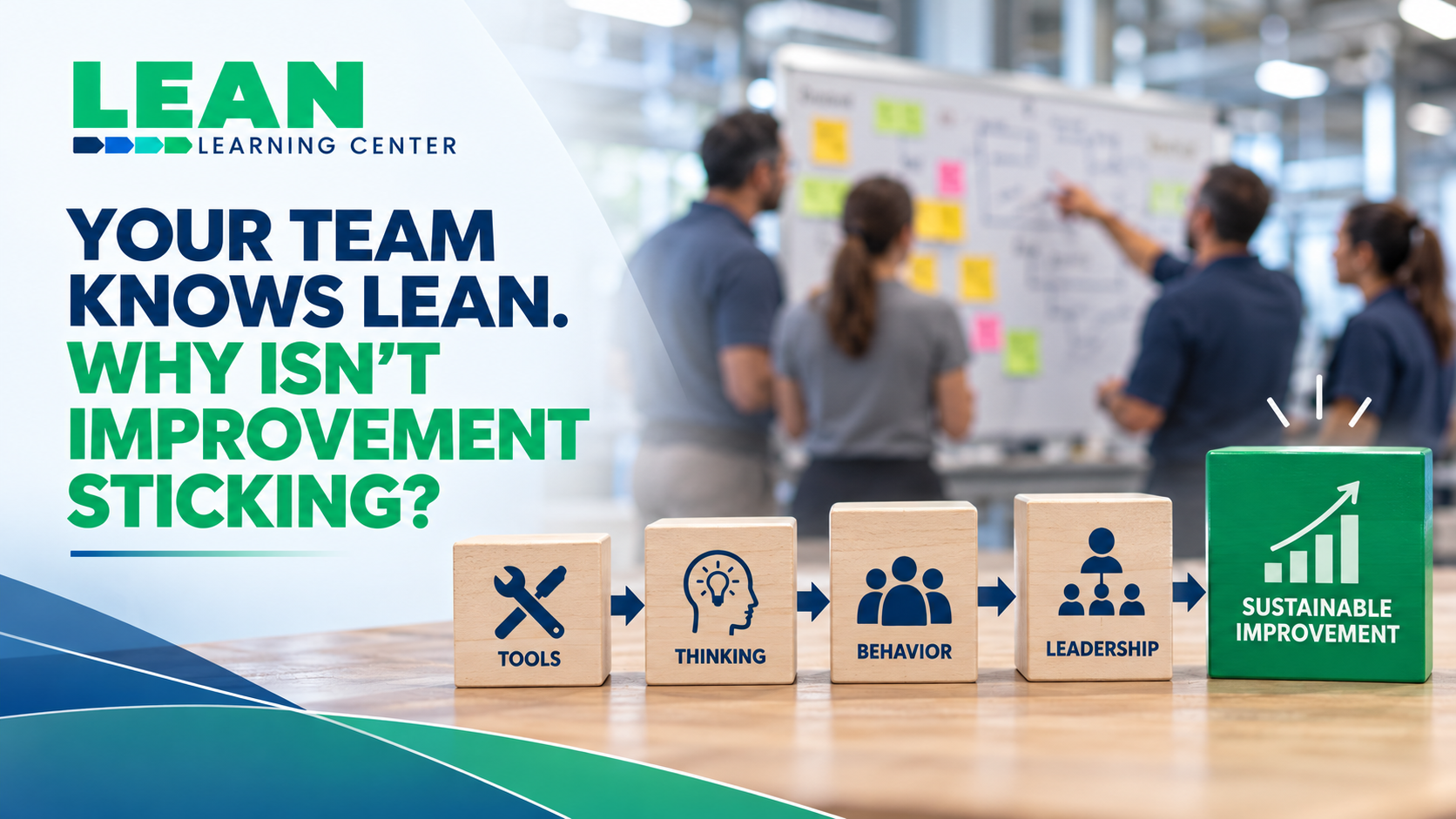
The bigger question is whether Lean has become part of how people think, lead, solve problems, and improve the work every day.
Knowing Lean and building an organization capable of continuous improvement are not the same thing.
You Already Have the Lean Tools. What Is Missing?
Organizations often begin their Lean journey with tools because tools are tangible.
You can teach 5S.
You can conduct a Kaizen event.
You can create a value stream map.
You can establish standard work.
You can train people in structured problem solving.
Each can produce meaningful improvements. But the presence of Lean tools does not automatically mean an organization has developed a sustainable improvement system.
Consider a few questions:
- What happens when the Lean or Continuous Improvement leader isn’t in the room?
- Do frontline leaders recognize and address problems differently because of their Lean development?
- Can managers coach teams through problems instead of immediately providing solutions?
- Do successful improvements spread beyond the team that created them?
- Do leaders across functions share a common way of talking about problems, processes, and improvement?
- Does improvement happen as part of daily work, or mostly during scheduled Lean activities?
The answers can tell you more about the maturity of your improvement system than the number of tools your organization has implemented.
The goal isn’t simply to have people who know Lean.
It’s to develop people who can use Lean thinking to improve the organization.
Why Knowing Lean Is Not the Same as Thinking Lean
Knowing a Lean concept in a classroom is one thing.
Recognizing when and how to apply it in an imperfect real-world process is another.
Someone may understand the definition of waste but still walk past unnecessary motion, waiting, rework, or excess processing every day.
A manager may understand root-cause analysis but still jump directly from a problem to a solution when production is under pressure.
A leader may understand the importance of developing people but continue solving problems for the team rather than coaching employees through the thinking themselves.
This is where organizations can become stuck between Lean knowledge and Lean capability.
Knowledge gives people concepts and tools.
Capability develops when people learn to recognize situations, apply what they know, observe what happens, reflect on the outcome, and adjust their thinking and actions.
That distinction becomes especially important when an organization wants improvement to continue without constant intervention from Lean specialists.
Sign #1: Improvement Depends on Specialists
A strong Continuous Improvement team can be a tremendous asset.
But it can also unintentionally become the place where improvement lives.
When there is a difficult process problem, who gets called?
When a Kaizen event needs to happen, who facilitates it?
When a team needs help identifying waste, who leads the discussion?
When improvement begins to stall, who is expected to get it moving again?
If the answer is consistently the Lean or CI team, the organization may have developed strong specialists without developing enough improvement capability throughout the rest of the business.
That creates dependency.
The CI team becomes responsible not only for supporting improvement but for making improvement happen.
The alternative isn’t to eliminate Lean expertise. Specialists still play an important role.
The goal is to extend capability beyond them.
Operations leaders, frontline managers, Quality, Engineering, HR/L&D, and other functions should increasingly be able to recognize problems, ask better questions, coach improvement, and participate effectively in solving the problems closest to their work.
A useful test is simple:
If your CI team disappeared for a week, would improvement continue?
If most improvement activity would stop, the organization may need to focus less on adding tools and more on distributing capability.
Sign #2: Events Create Results, but the Results Do Not Spread
A Kaizen event can generate impressive results.
A team improves flow. Lead time drops. A process becomes simpler. Employees eliminate unnecessary steps. Performance improves.
That is valuable.
But what happens next?
Does another department learn from it?
Do leaders identify principles that can be applied elsewhere?
Does the new process become the standard?
Do teams continue improving after the event ends?
Or does everyone eventually move on to the next project?
Sustainable Lean improvement cannot depend entirely on isolated events.
Events can accelerate learning and change, but the organization also needs mechanisms for carrying that learning forward.
That means asking questions such as:
What did we learn?
Why did this change work?
Where else does the same condition exist?
What should become the new standard?
What should leaders reinforce going forward?
Without that reflection and follow-through, an organization can accumulate many successful projects without building a stronger improvement system.
The individual results may be real.
The organizational learning remains limited.
Sign #3: Leaders Use Different Improvement Languages
Put several leaders from different functions in front of the same process and ask them what they see.
One might see a staffing problem.
Another sees equipment.
Another sees quality.
Another sees scheduling.
Another may not see a meaningful problem at all.
Different perspectives are valuable. But when leaders lack a common way of thinking about work and improvement, it becomes harder to align around problems and sustain change.
Lean provides more than tools. It can provide a shared way of looking at processes, value, waste, flow, problems, learning, and leadership.
That common language matters.
It doesn’t mean every leader needs to reach the same conclusion.
It means they have a stronger foundation for examining the system together.
Without that foundation, improvement can become fragmented.
One department pursues efficiency while another optimizes quality. One leader expects managers to solve problems while another expects managers to coach their teams. One site embraces experimentation while another avoids changing established practices.
Eventually, Lean begins to look different depending on where you stand in the organization.
A sustainable improvement system requires greater alignment not only around which tools to use, but around how leaders think about improvement itself.
Why Learning Must Move From Knowledge to Application
Traditional training can be very effective at introducing concepts.
But information alone rarely changes behavior.
Imagine learning to swim entirely from a presentation.
You could learn the terminology. You could study body position, breathing, and different strokes. You might even pass a written assessment.
But eventually, you have to get into the water.
Lean development has a similar challenge.
People need opportunities to take what they have learned and apply it.
They need to make decisions.
They need to encounter uncertainty.
They need to see what happens when an idea meets the realities of a process.
And they need opportunities to think about the results.
That is where learning begins moving from something a person knows toward something a person can do.
Learn → Apply → Reflect
One useful way to think about capability development is through a simple cycle:
Learn
Introduce the principle, concept, or way of thinking.
People need enough understanding to know what they are looking for and why it matters.
Apply
Give people an opportunity to use what they learned.
Application reveals something that explanation alone cannot: the gap between understanding an idea and being able to act on it.
Reflect
Ask what happened.
What worked?
What didn’t?
What assumptions turned out to be wrong?
What would you do differently next time?
What does this mean for the real work back in your organization?
Reflection turns an activity into a learning opportunity.
And then the cycle begins again.
Learn → Apply → Reflect → Learn again.
Over time, that repeated experience can help people develop stronger judgment, problem-solving capability, and confidence applying Lean principles in situations that do not come with a step-by-step instruction sheet.
Build People Who Can Lead Improvement After Training Ends
The real test of Lean training isn’t what participants can explain at the end of class.
It’s what they can see and do differently afterward.
Can they recognize a problem they previously overlooked?
Can they ask better questions?
Can they coach rather than immediately provide an answer?
Can they connect an isolated problem to the larger process?
Can they help others participate in improvement?
Can they take what worked in one area and help the organization learn from it?
Ultimately, sustainable continuous improvement requires more than a collection of tools.
It requires capability throughout the organization.
That doesn’t mean everyone needs to become a Lean expert.
It means improvement should not depend entirely on one.
From Knowing Lean to Experiencing It
If your organization already knows the Lean tools but improvement still fades, the next step may not be adding another tool to the toolbox.
It may be developing the people who are expected to use those tools, lead improvement, coach others, and help Lean become part of how the organization operates.
That is the thinking behind The Lean Experience®.
Rather than focusing only on information transfer, participants move through a cycle of Learn → Apply → Reflect, connecting Lean principles with hands-on learning, application, discussion, and reflection.
The goal is not simply to leave knowing more about Lean.
It is to return to work better prepared to see, think about, and lead improvement differently.
The Lean Experience®
November 9–13, 2026
Oakland University | Rochester, Michigan
Learn more and explore the program: