When organizations invest in Lean training, one of the first questions is often, “Who should attend?”
The usual answers are predictable: the Continuous Improvement team, Lean practitioners, Operations managers, or employees already involved in improvement projects.
These are reasonable choices. But they may not be the best place to start.
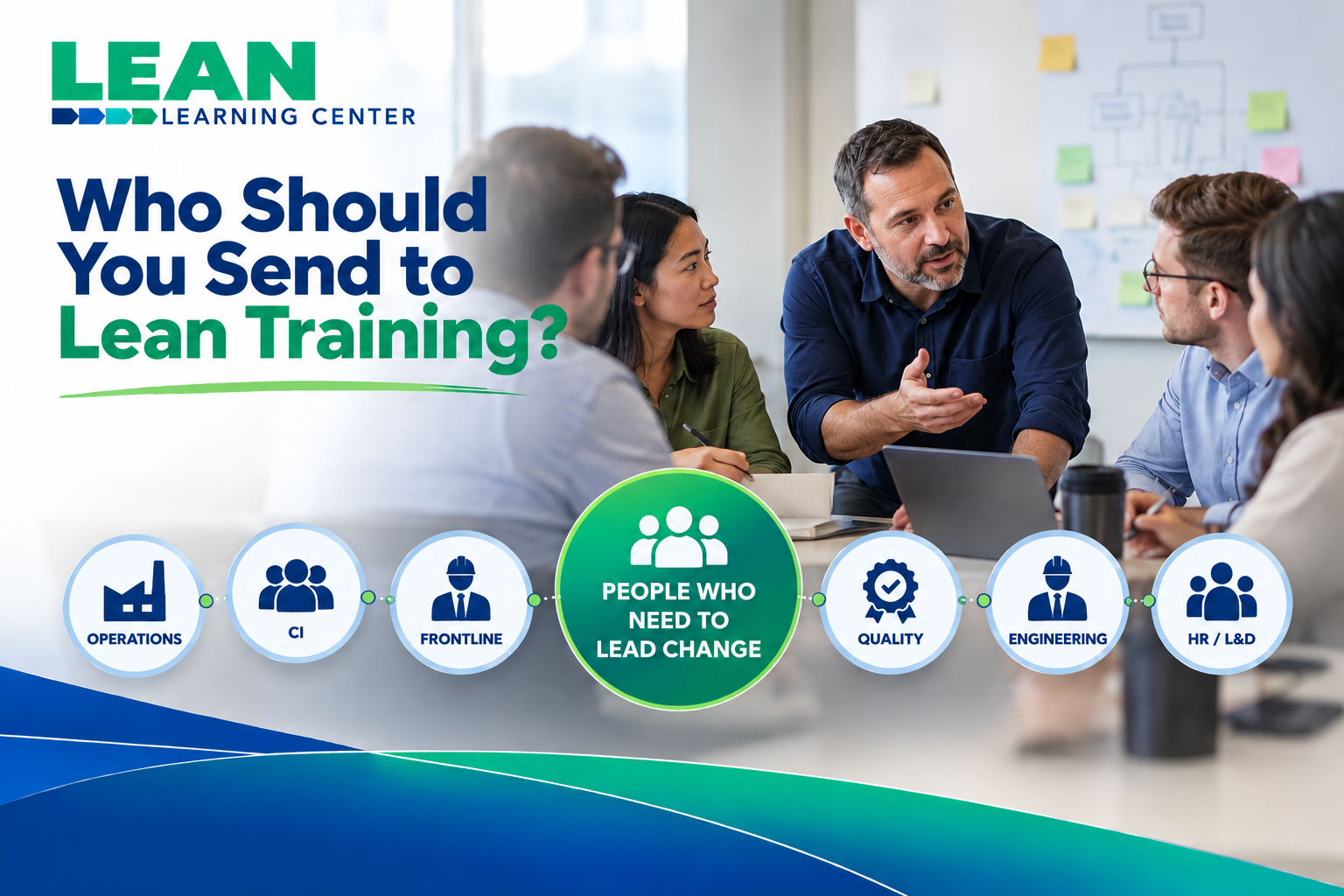
The most important question is not who has Lean in their job title. It is who needs the capability to lead meaningful change.
An organization may have knowledgeable Lean specialists and still struggle to sustain improvement. A Plant Manager might need stronger coaching skills. Frontline supervisors may need more confidence identifying and solving problems. Quality and Operations leaders may need a shared approach to improving processes.
The right training investment depends on what the organization needs to accomplish and who will be responsible for making it happen.
Here is a practical framework for identifying the people who could benefit most from Lean development.
1. Don’t Start With Job Titles. Start With the Change You Need.
Before selecting participants, consider the business challenges your organization is trying to address.
Are recurring problems slowing production? Are improvement efforts dependent on a small group of specialists? Are departments struggling to work together? Are leaders having difficulty sustaining improvements after a successful project?
Different challenges require different capabilities.
For example, if improvement depends entirely on the CI department, sending another CI specialist to training may strengthen technical expertise without addressing the underlying dependency.
The greater opportunity may be to develop managers and supervisors who can recognize problems, involve employees, and lead improvement in their daily work.
Ask three questions before choosing participants:
- What operational or organizational challenge are we trying to improve?
- Who has the responsibility or influence to address that challenge?
- What new thinking, behaviors, or leadership capabilities do those people need?
These questions help connect Lean training to real business needs rather than simply filling available seats.
2. The Operations Leader: Connecting Lean to Daily Performance
Operations leaders are responsible for turning organizational goals into consistent performance.
They manage competing priorities involving productivity, quality, delivery, cost, staffing, and customer expectations.
Because of these responsibilities, Operations leaders have a significant influence on whether Lean becomes part of everyday work or remains a collection of occasional improvement projects.
An Operations leader may benefit from Lean training when they need to:
- Recognize process problems rather than focus only on performance symptoms.
- Understand how decisions affect the broader value stream.
- Coach teams to identify and address the causes of recurring issues.
- Establish expectations that support daily improvement.
- Connect improvement activities to operational goals.
Consider an Operations Manager whose team repeatedly misses production targets.
The immediate response might be to add overtime, adjust staffing, or push employees to work faster.
A stronger Lean approach asks different questions.
Where is work being delayed? What causes variation? Which activities create value? What conditions prevent employees from completing work consistently?
The goal is not simply to make a better short-term decision. It is to develop a more effective way of understanding and improving the process.
When Operations leaders think differently about problems, they can help their teams work differently too.
3. The CI Leader: Building Capability Beyond the Improvement Department
Continuous Improvement professionals are often among the first employees selected for Lean training.
They facilitate improvement events, support problem-solving activities, introduce Lean methods, and help teams identify waste.
Their expertise is valuable.
However, organizations can become overly dependent on the CI team.
When employees believe improvement belongs to specialists, managers may wait for someone else to facilitate change.
This creates a difficult situation: the organization has Lean expertise, but that expertise is concentrated in a small group.
CI leaders may need development that helps them move beyond implementing tools and toward building improvement capability throughout the organization.
That includes learning how to:
- Coach others through problems rather than provide every answer.
- Help leaders understand the principles behind Lean practices.
- Encourage ownership of improvement within operating teams.
- Develop a shared approach to problem-solving across departments.
- Support improvements that continue without constant specialist involvement.
A successful CI leader does more than complete improvement projects.
They help create an organization where more people are capable of identifying opportunities, making improvements, and sustaining results.
4. The Frontline Leader: Turning Lean Thinking Into Daily Behavior
Frontline supervisors and team leaders work closest to the processes that create value.
They see operational problems as they happen. They understand the challenges employees encounter. They also influence how teams respond when something goes wrong.
This makes frontline leadership development especially important.
A supervisor who sees every problem as an interruption may focus on restoring output as quickly as possible.
A supervisor who has developed stronger Lean thinking may also ask why the problem occurred and what the team can learn from it.
The difference can influence how improvement happens across an entire department.
Frontline leaders may benefit from training that develops their ability to:
- Recognize abnormalities and recurring problems.
- Ask effective questions instead of immediately giving instructions.
- Involve employees in problem-solving.
- Understand the purpose of standard work.
- Encourage reflection after changes are implemented.
- Make improvement part of regular team conversations.
Imagine two supervisors facing the same recurring equipment delay.
One repeatedly finds a temporary workaround.
The other involves the team in understanding why the delay keeps happening, tests an improvement, and follows up to determine whether it worked.
Both supervisors want production to continue.
But the second is also developing the team’s ability to improve the process.
Lean capability becomes more valuable when it changes what leaders do every day.
5. Quality and Engineering Leaders: Improving the System Together
Quality and Engineering leaders bring important technical perspectives to organizational improvement.
Quality professionals often focus on defects, variation, compliance, and customer requirements.
Engineering professionals may focus on equipment, process design, technical capability, and production efficiency.
These perspectives are essential, but improvement can become fragmented when departments approach problems independently.
A quality issue may appear to be a training problem to one team, an equipment problem to another, and a scheduling problem to Operations.
Each perspective may reveal part of the situation.
Lean thinking helps teams examine the process as a connected system rather than treating every issue as an isolated departmental concern.
Quality and Engineering leaders may benefit from Lean development when they need to:
- Work more effectively across functional boundaries.
- Understand how process design influences operational performance.
- Recognize waste and variation throughout the value stream.
- Use a common approach to investigating problems.
- Collaborate with Operations and CI teams on sustainable solutions.
Consider a recurring product defect.
Quality may identify the defect through inspection. Engineering may investigate equipment settings. Operations may focus on meeting production schedules.
Without a shared improvement approach, each department may address its immediate concern without resolving the broader process issue.
Developing common Lean thinking can help these leaders work together to understand the problem and improve the system.
6. The HR or Learning Leader: Connecting Training to Organizational Capability
HR and Learning & Development professionals may not be the first people considered for Lean training.
However, they can play an important role in helping organizations build and sustain improvement capability.
Training programs are often evaluated through participation, completion, and employee feedback.
These measures provide useful information, but they do not necessarily show whether learning changes workplace behavior.
A course can receive excellent evaluations while having little lasting effect on how people solve problems or lead teams.
HR and L&D leaders can help organizations ask more meaningful questions:
- What capabilities should participants develop?
- How will those capabilities support business priorities?
- What opportunities will employees have to apply their learning?
- How will managers reinforce new behaviors?
- What evidence will show that the training made a difference?
This shifts the focus from delivering training to developing people.
For example, an organization may want supervisors to become more effective improvement coaches.
Rather than treating training as a standalone event, HR and Operations can work together to identify the expected behaviors, provide opportunities for practice, and establish follow-up expectations.
The result is a stronger connection between employee development and organizational performance.
7. Why Sending Several People Can Create a Shared Improvement Language
Sometimes, the best approach is not to send one person.
It is to develop several people who must work together to lead improvement.
Imagine an organization sends only its CI Manager to Lean training.
That individual may return with useful ideas and stronger capabilities.
But what happens when they try to apply those ideas?
The Plant Manager may have different priorities. Supervisors may interpret problems differently. Quality and Engineering may approach improvement through separate methods.
The trained employee now faces an additional challenge: helping everyone else understand and support the new approach.
Compare that with an organization that develops several connected leaders.
An Operations Manager, CI professional, frontline supervisor, and Quality leader may return with a shared understanding of Lean principles and a more consistent way of discussing problems.
They can reinforce the same thinking across their respective responsibilities.
This does not mean everyone needs identical expertise.
It means the people responsible for leading change benefit from a common foundation.
A shared improvement language can make it easier to collaborate, align decisions, and sustain progress.
For organizations considering group development, the most useful question may be which combination of participants will have the greatest influence on the changes they want to achieve.
8. What Should Participants Bring Back to Work?
Selecting the right participants is only part of the decision.
Organizations should also consider what they expect employees to do differently after training.
More knowledge is useful, but knowledge alone does not guarantee improvement.
Before employees attend a Lean program, leaders can establish clear expectations for how the learning will be applied.
For example, participants might be expected to:
Recognize problems more effectively. Identify process issues, waste, and opportunities that previously went unnoticed.
Ask better questions. Move beyond immediate symptoms to understand what is happening within the process.
Apply Lean principles to real work. Connect concepts learned during training to the organization’s operational challenges.
Coach and involve others. Help employees participate in improvement rather than relying exclusively on specialists.
Collaborate across functions. Use a common approach when discussing processes and solving problems.
Reflect and follow through. Evaluate whether changes produced the intended results and determine what to improve next.
Managers can support these outcomes by giving participants opportunities to practice and apply what they learned.
A useful follow-up conversation might include:
- What did you learn that changed how you see our processes?
- Which problem should we examine differently?
- What can you apply with your team?
- What support will you need?
- How will we know whether the change is working?
These conversations help turn training into an ongoing development process.
9. A Practical Framework for Choosing Your Lean Training Participants
If your organization is deciding whom to send to Lean training, start with these four steps.
Step 1: Identify the improvement challenge
Choose a meaningful business problem or capability gap.
Examples include recurring quality issues, inconsistent processes, limited improvement ownership, or poor collaboration between departments.
Step 2: Identify the people who influence that challenge
Consider who makes decisions, manages the process, coaches employees, and supports improvement.
Look beyond formal job titles.
Step 3: Determine the capabilities they need
Identify whether participants need stronger problem-solving, process thinking, coaching, leadership, or cross-functional improvement capabilities.
Step 4: Plan how the learning will be applied
Give participants opportunities to practice, reflect, and contribute to improvement when they return.
This approach helps organizations make more intentional training decisions.
Instead of asking who is available to attend, they can ask who is best positioned to help the organization move forward.
10. Develop the People Who Need to Lead Change
Lean training can be a valuable investment, but its impact depends on more than the content delivered during the course.
It also depends on who participates, what capabilities they develop, and how those capabilities are applied afterward.
For some organizations, the priority may be an Operations leader who needs to coach improvement more effectively.
For others, it may be a CI professional who needs to develop capability beyond their department, a frontline supervisor who influences daily behaviors, or a group of leaders who need a common way of thinking.
There is no single job title that automatically makes someone the right participant.
Start with the change your organization needs. Then develop the people who can lead it.
Experience Lean Through Learning, Application, and Reflection
The Lean Learning Center’s Lean Experience® is designed to help participants move beyond simply knowing Lean tools.
Through a Learn → Apply → Reflect approach, participants engage with Lean principles through hands-on learning, discussion, simulation, and reflection.
The next Lean Experience® takes place November 9–13, 2026, at Oakland University in Rochester, Michigan.
If your organization is deciding who should receive Lean development, consider the people who need to become stronger leaders of improvement.
Explore The Lean Experience® and learn more about the program: